
Why the Quality of Your Fish Oil Matters
Not all fish oils are created equal
Fish oil is one of the most researched nutritional supplements available and can play an important role in supporting heart health, brain function, inflammation, mood, eye health and healthy ageing. However, because fish live in our oceans, they are also exposed to environmental pollution. As a result, fish oils can contain tiny amounts of contaminants if they are not carefully purified and tested. This doesn't mean you should avoid fish oil, it means that choosing a high-quality product is important, especially if you plan to take it every day for many years.
Why do contaminants matter?
The world's oceans are becoming increasingly polluted with substances such as:
Mercury
Lead
Cadmium
Arsenic
Industrial chemicals (such as PCBs and dioxins)
Microplastics
These pollutants can enter the food chain and eventually be found in fish. Fortunately, reputable manufacturers use sophisticated purification methods to remove the vast majority of these contaminants before the oil reaches the consumer.

Mercury and long-term exposure
One of the contaminants people often ask about is mercury. Mercury can affect the nervous system, kidneys and developing brain. Although our bodies can slowly eliminate mercury, it does not disappear immediately. Small amounts are removed over time, but repeated exposure over months and years can gradually increase the body's total burden.
For most people, a single source of mercury is unlikely to cause problems. However, fish oil is often taken every day for many years, and it is only one of many potential environmental exposures we experience.
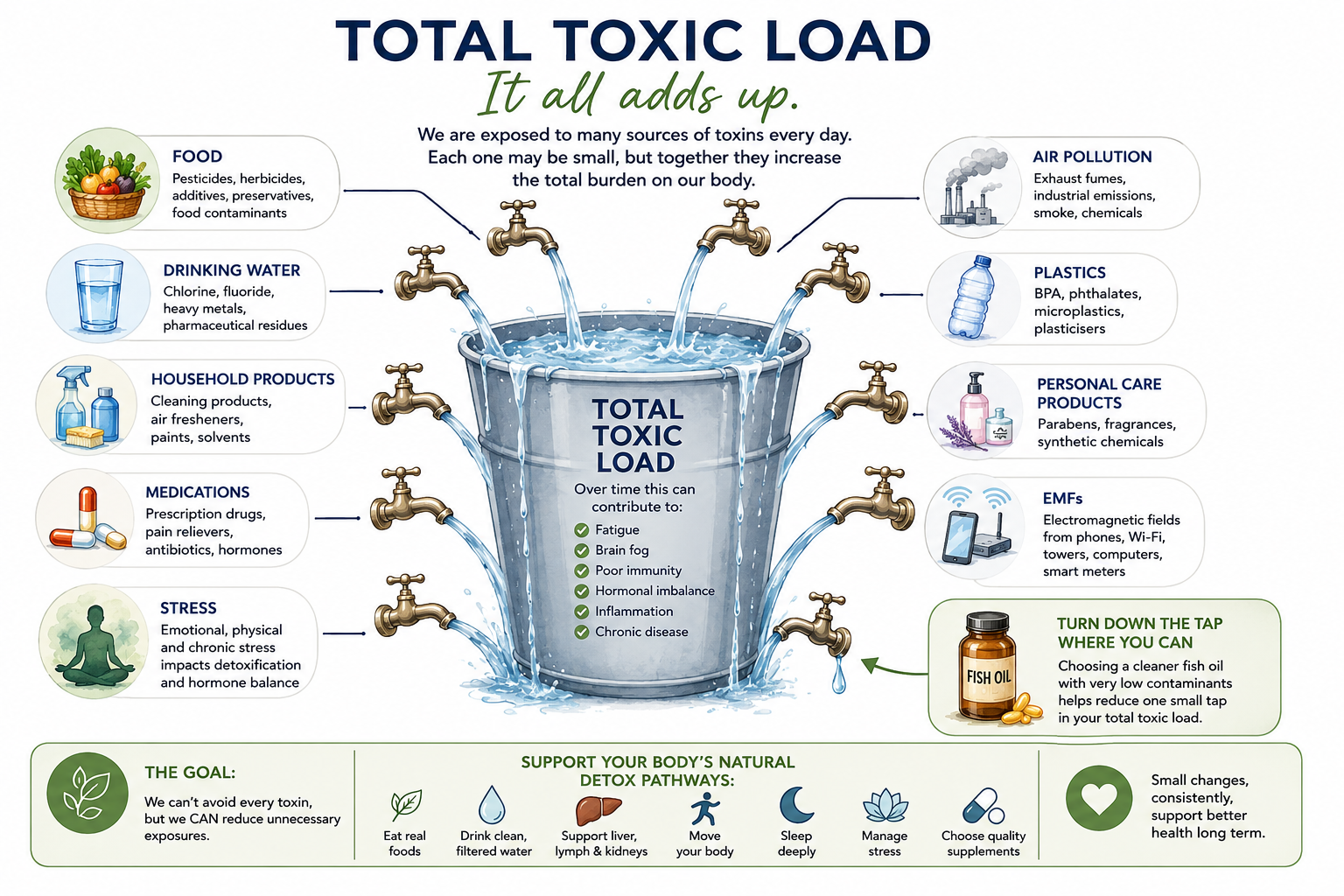
Today we are also exposed to pollutants from:
Food
Drinking water
Air pollution
Household products
Plastics
Personal care products
Pesticides and herbicides
Each individual exposure may be small, but together they contribute to what practitioners sometimes refer to as your overall toxic load. Because of this, it makes sense to reduce unnecessary exposures wherever practical.
Why practitioners often recommend premium brands
Some manufacturers invest heavily in:
Carefully selecting fish from cleaner waters
Using small wild fish that naturally accumulate fewer contaminants
Advanced purification methods such as molecular distillation
Multiple rounds of laboratory testing
Independent third-party testing
Batch-by-batch quality control
Many premium brands publish Certificates of Analysis or use independent laboratories to verify that their products contain extremely low—or undetectable—levels of heavy metals and other contaminants.
This level of transparency provides greater confidence in the product's long-term safety.

What does the TGA require?
In Australia, fish oil products sold as therapeutic goods must meet strict standards set by the Therapeutic Goods Administration (TGA).
These standards place maximum allowable limits on contaminants such as heavy metals and require testing for purity and freshness. This provides an important level of consumer protection.
However, these limits represent the highest level that is legally acceptable—they are not the level that manufacturers aim for. Think of it like a speed limit. The speed limit on a road might be 100 km/h, but some careful drivers travel below that speed when conditions require it.
In the same way, high-quality supplement companies aim for contaminant levels that are far below the maximum allowed, often so low they cannot even be detected by modern laboratory equipment.
Mercury isn't the only concern
Interestingly, one of the biggest quality differences between fish oils is not mercury—it's freshness.
Fish oil is delicate and can become oxidised when exposed to heat, light or oxygen.
Oxidised fish oil:
Has a stronger fishy smell or taste
Is less stable
Is inflammatory in the body
High-quality manufacturers test every batch to ensure the oil remains fresh and stable throughout production.
My philosophy
As part of your treatment plan, I may recommend fish oil for long-term use. Whenever a supplement is taken daily for months or years, quality becomes increasingly important, so rather than simply asking, "Is this product safe?" I ask a better question:
"Is this one of the cleanest and highest-quality products available?"
By choosing supplements with exceptionally low contaminant levels, we reduce one small but meaningful source of environmental toxin exposure. No supplement can eliminate all environmental pollutants, but reducing unnecessary exposure where we can is a sensible, preventative approach to long-term health.